Why You Should Read 'An Immense World'
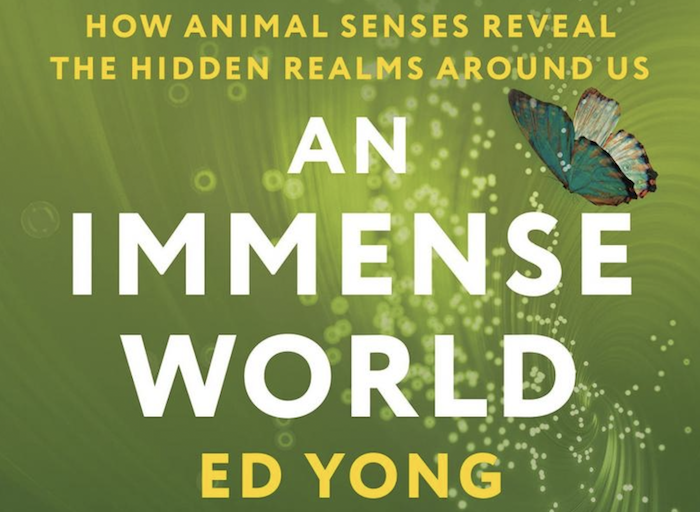
Ed Yong’s An Immense World is a book on animal senses. If you’ve ever wondered what a bird sees or how fish communicate then this book is for you. If such thoughts never cross your mind, then you need to read this book to see what you’re missing.
Yong is an American science journalist and has won several awards for explanatory reporting, including the 2021 Pulitzer Prize for his coverage of the COVID-19 pandemic. An Immense World is based on the latest science on sensory biology. Yong takes scientific findings regarding animal senses and weaves them into a story about the rich diversity of ways in which animals sense the world. In the process he reveals a hidden, vibrant world that we humans do not even perceive. It is a story of alternate realities as fantastic as science fiction.
To explain the complex subject Yong uses the concept of Umwelt popularized by German zoologist Jakob von Uexküll in 1909. Umwelt refers to an animal’s sensory bubble, the part of its environment that it can sense and experience. Each Umwelt is limited because our senses filter only what we need. Earth “teems with sights and textures, sounds and vibrations, smells and tastes, electric and magnetic fields” but each animal species can only percieve a sliver of reality.
Human Umwelt is determined to a large extent by our excellent vision (only birds of prey have more acute daytime vision). We often misinterpret animal behavior because we judge them by the standards of our Umwelt. A seal swimming upside down? No, the seal is not relaxing, it is probably scanning the seafloor for food because a seal’s visual field has excellent coverage above its head, not straight ahead like it is for humans. We think cows are placid creatures because their gaze is so fixed, but they rarely turn to look because they don’t need to. Their visual fields wrap almost all the way around their heads. A cow can see in front, to the side, and behind at the same time. As Yong explains:
“Looking around, which is inextricable from our experience of vision, is actually an unusual activity, which animals do only when they have restricted visual fields…”
We have a harder time comprehending Umwelten of animals that do not perceive the world in a primarily visual way. Take dogs for example. It is common knowledge that they have an excellent sense of smell but we fail to truly appreciate how, as a result, their perception of the world must fundamentally differ from ours. Light moves in a straight line but smells “diffuse and seep, flood and swirl”, travel through darkness and around corners. With help from an expert on dog olfaction, Yong describes how dogs perceive the world as a shimmering landscape of smell.
And if canine Umwelt can be so confounding, wait till you read about echolocating bats, birds with ultraviolet vision, whale songs that can traverse oceans, and spiders that use electric fields to float.
Scientists have studied animal senses forever and Yong draws on findings both old and new. Each chapter in the book is dedicated to a specific sense, beginning with the most universal senses: smell and taste. Then come chapters on vision, pain, and heat, and the various mechanical senses: touch, vibration, hearing, and echolocation. Finally, the more esoteric senses that animals use to detect electric and magnetic fields.
You will discover the wonderfully diverse ways in which animals sense the world. Some senses are well understood by scientists and some remain mysterious. Along the way, you will learn about the Umwelt of sensory biologists, or at least the strange methods they devise to study animal senses.
The book is written in a breezy, humorous storytelling style that makes for a fun read. There is also a thread exploring our relationship with nature running through the book. For Yong, animals have worth in themselves and cannot be ranked or measured based on their utility to us humans. So he explores their senses and abilities from a place of wonder and curiosity in order to better understand their lives. Our curiosity to understand other Umwelten makes us unique in the animal kingdom. In the process of understanding other perspectives, we learn that the world is more immense and wonderful than what our senses reveal.