Museums of Memory
When I travel to a new place, I look for local museums of history and culture. Objects displayed in a museum are curated to tell stories about the place and its people. I think of museums as a portal into a community’s stories and memories, quiet spaces for learning and reflection.
There are museums of all kinds ranging from well-endowed ones that tell stories of entire nations to smaller museums with a niche focus. Visiting an offbeat, niche museum is a particular pleasure. I discover them in back pages of travel books or by chance while wandering around or in conversation with a fellow traveller. While walking around Little Havana, Miami, I stumbled onto a little museum-library filled with artifacts from the failed 1961 Bay of Pigs invasion by Cuban exiles. I understood Miami a little better thanks to that unexpected visit. When I travelled to Iceland, a detour to Bogarnes to see a quirky museum about an Icelandic Saga was well worth the time. The museum profiles the hero of Egils Saga, one among the many sagas of Iceland, which are sort of like origin stories about Iceland.
Then there are museums that take visitors on an emotional journey through a difficult past. These are spaces that chronicle an unjust and violent past so that grievous harm is not erased or forgotten. Those who do not remember the past, after all, are condemned to repeat it. Such museums, in addition to documenting the past and serving as keepers of memory, also memorialize victims and honour those who fought against injustice despite the threat of violence. They serve as a place of collective mourning for lost lives and a future that could have been. These museums are more than checkmarks on a travel itinerary. Their stories stay with you long after your visit.
Here are four memory museums that left a deep impression on me, listed in reverse chronological order by date I visited them.
-
The National Museum of African American History and Culture, Washington, D.C. (visited in 2017)
This museum documents African American life, history, and culture, and was decades in the making. It opened in September 2016 in the National Mall area of Washington, D.C. The National Mall is a landscaped park close to the White House and bordering a dozen or so museums and memorials. The museum is large with four floors above ground and three floors below. The three underground floors house the history galleries that cover African American history from 1400 to 1968 and beyond.
If you are new, they recommend starting from the bottom floor in the bowels of the building and working your way up the history galleries to the ground floor level. As you climb, you move through time with each floor covering slices of history, starting with the transatlantic slave trade through segregation and the civil rights movement. It is American history like I had never seen before.
There are many other galleries about contemporary life and culture in the museum’s upper floors. You need multiple visits to see them all. The museum has a good open access initiative where they make images of museum artifacts available to view and download.
-
Apartheid Museum, Johannesburg (visited in 2018)
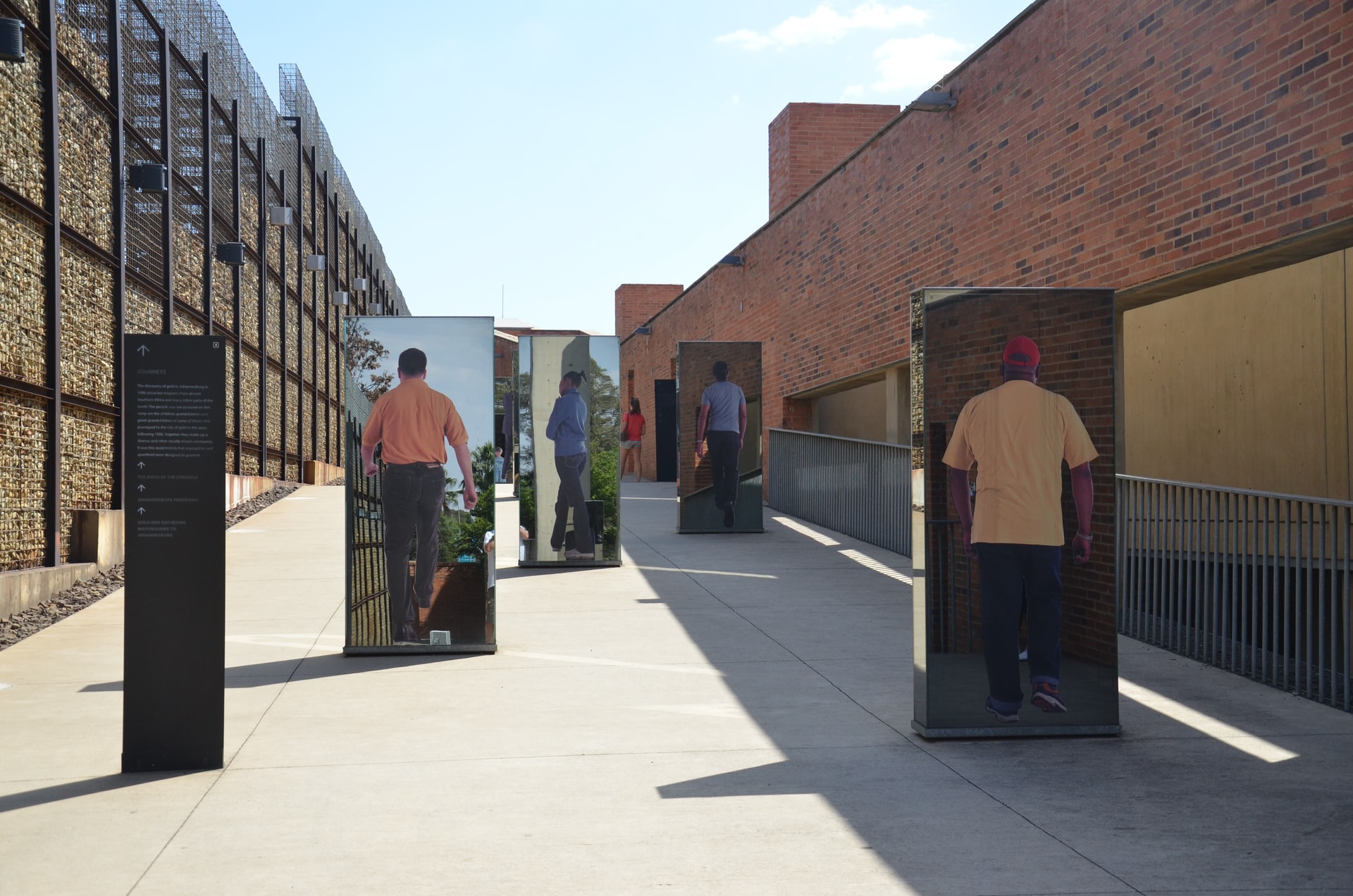
Opened in 2001, this museum tells the story of twentieth century South Africa, which was defined by apartheid. The museum campus is well-designed with multiple exhibit rooms connected by landscaped pathways. We were given apartheid-era race classifications along with our tickets to the museum. I was given an ID that said “white” and my partner was given one that said “non-white.” At the entrance, we entered through the gate allocated to our respective race groups. We each entered into an exhibit in a prison-like enclosure with photos and text explaining the legal framework that controlled everything in the apartheid-era. The “non-white” side learning about restrictive rules that governed their lives and the “white” side about the privileges granted to them. After this immersive experience, we walked to the other exhibits that take visitors from 1910 through 1995, chronicling the rise and fall of apartheid. The museum’s website has summary information about the permanent exhibits and some additional resources like e-books for children.
-
The Holocaust History Museum, Yad Vashem, Jerusalem (visited in 2014)
Yad Vashem was established in 1953 as Israel’s official memorial to the victims of the Holocaust. It is a sprawling campus built on a hillside in Jerusalem that houses museums, memorials, and research centers. I only visited Yad Vashem’s Holocaust History Museum (because of lack of time). The museum is mostly underground, shaped like a long concrete prism that tunnels through the hillside and juts out of both sides of the hill. The upper edge of the prism cuts through the top of the hill and is made of glass, sending intermittent shafts of sunlight inside. The museum documents the evolution of European anti-Semitism, Nazi Germany, and the Holocaust. It also houses a memorial to every Jew who died in the Holocaust. The museum’s website has summary information about its galleries. Yad Vashem literally means “a memorial and a name” in Hebrew.
-
Yuyanapaq, Lima (visited in 2010)
Yuyanapaq, meaning “in order to remember” in Quechua, is a photo exhibition commissioned by Peru’s Truth and Reconciliation Commission (TRC) to serve as a visual memory of Peru’s internal conflict from 1980 to 2000. The TRC was created in 2001 to investigate violence during the conflict.
In its two-year investigation, the TRC travelled across Peru to collect individual testimonies and compiled thousands of documents, including photos, to reconstruct historical events. Yuyanapaq, which was inaugurated in 2003, was curated from archives of independent photographers, newspapers, human rights organizations, family albums, churches, and police and military institutions. The curators, photojournalists who had covered the conflict, selected 300 photos that were both poignant and aesthetic. The photos, except for a handful, did not show graphic evidence of violence. Instead, they showed what those affected by the conflict may have felt while they suffered, mourned, organized or defended themselves, allowing the viewer to connect with and confront the human tragedy caused by the conflict.
The photos were arranged chronologically, consistent with the findings unearthed by the TRC. The final area of the exhibit was the testimonial room, lined with six ID card photos of Peruvians that died or disappeared in the conflict, enlarged to life-size and hung evenly spaced from the ceiling on backlit frames. The room is filled with low, unintelligible murmurs. I had to stand close to each image to hear the individual testimony accompanying each photo. The testimony is in the voice of a family member of the victim, relating the circumstances around their loved one’s disappearance or death. As I stood there among memories of an unfamiliar conflict, I mourned too.
In 2015, the Place of Memory, an institution dedicated to commemorating and creating dialogue about the internal conflict was inaugurated in Lima. I have not yet visited this new space, but its website has a virtual visit feature which is pretty good.