A Scaffolding for Time
They say you are what you read, so in a burst of introspection I organized books I had read recently. I select books to read based on suggestions from friends, book clubs, and based on my own interests and curiosity. In doing so I had accumulated a collection of seemingly random books.
I sorted and shelved books by category, a process that was meditative and unexpectedly pleasurable. I ended up with 36 categories in total, with most books falling in multiple categories. There was an almost even split between fiction and non-fiction, with fiction having a slight edge. The category with most books was fantasy. No surprises there. The second place was a draw between history (non-fiction) and historical fiction.
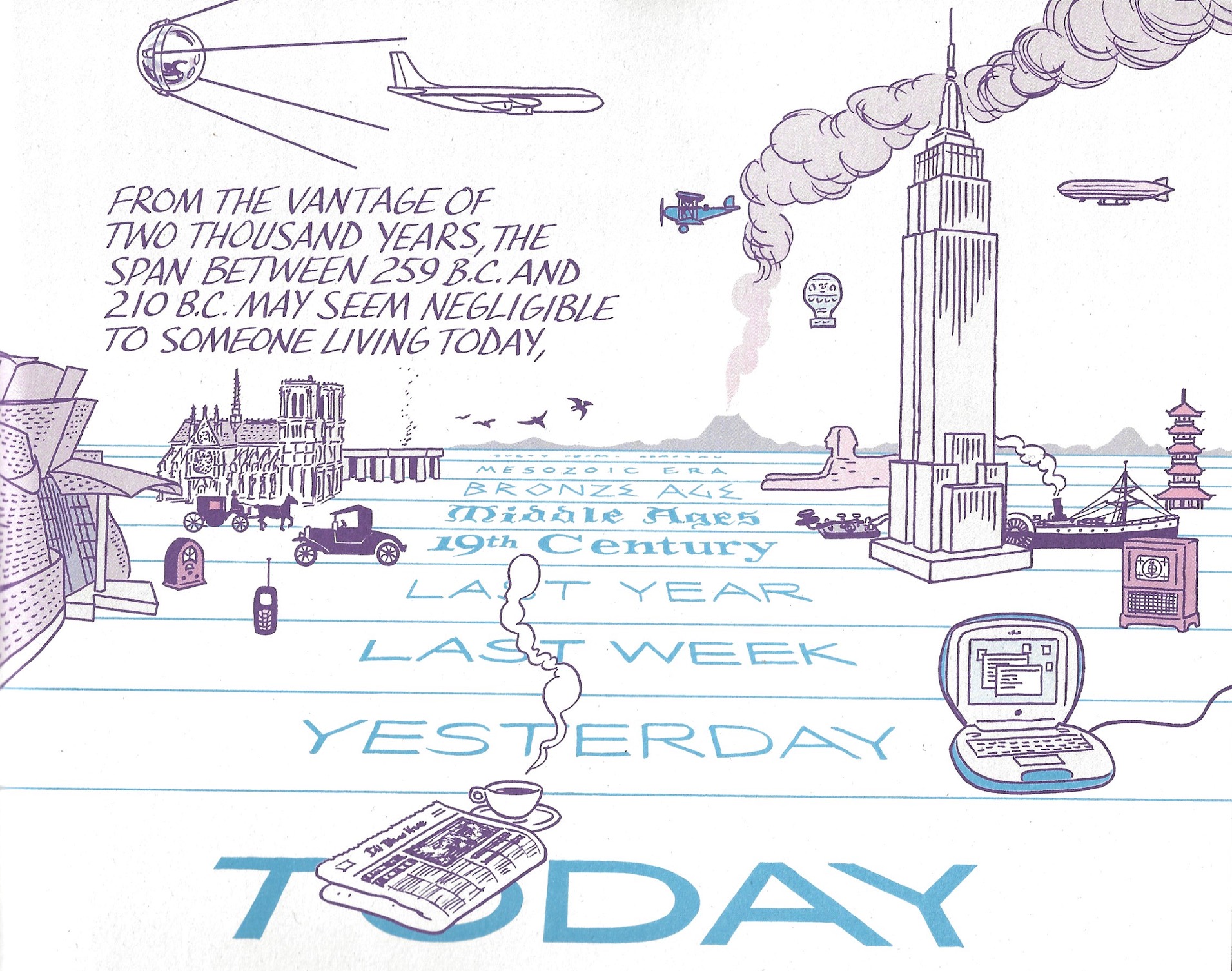
I was also not surprised by the number of non-fiction history titles. I love history. It is a thrill to discover echoes of the past in the current zeitgeist. Reading history changes the way I think about the past not only in the sense of learning about past events but also quite literally my conception of time that has passed. Let me explain. When I look into the past, say a hundred years ago, time appears flat and structureless. Unless I consciously thought about it, I would not really appreciate that there’s a span of thirty years between 1901 and 1931. I would think of the entire thirty-year period as a formless blob called the early twentieth century. The further back I go in time, the greater amount of it I flatten. The fifteenth and sixteenth centuries could have passed by in an instant for all I know. The cover image (see above) describes this visually.
Reading history helps me build a scaffolding around time that has passed so that it is no longer formless. Since I have been reading history books about the nineteenth and early twentieth century, I can appreciate that thirty-year bridge between 1901 to 1931. Details about people and events from those thirty years are the materials I use to build the scaffolding that structures that time.
The fifteenth and sixteenth centuries are still formless to me. That is because I know of a handful events that occurred in those two hundred years, which is not enough material for me to build a mental scaffolding for that time. The further back in time we go, there are lesser records available, so it gets harder to obtain enough details for our mental scaffoldings. Classifications of chunks of time like the Bronze Age or the Gupta Period may be useful ways to think about the distant past but by definition these categories flatten decades or centuries worth of time.
The number of books I had read in the category of historical fiction was a surprise to me. I had not realized I was reading so much of it. I suppose it is natural that I am drawn to it given my love for history. The cover image is accompanied by the following text (only a part of it is seen in the image above):
[The First Emperor of China], born in 259 BC, expired in 210 BC, before he could celebrate his fiftieth birthday.
From the vantage of two thousand years, the span between 259 BC and 210 BC may seem negligible to someone living today, but each of those 1800 days must have been as precious and unpredictable as this one. After all, who knows which day will be his last?
And therein lies the attraction of historical fiction, the genre of stories capturing the richness of everyday life lived in the past. These stories attempt to convey the social conditions of the past as accurately as possible. They are a product of imagination stitched around historical facts and often contain a mix of fictional and real historical characters. There are some stories set in the past with obviously speculative or fantastical elements. These have their charms: A Case of Exploding Mangoes by Mohammed Hanif and Kindred by Octavia E. Butler are good examples. My favourite, however, are elaborate stories that plumb the breadth and depth of social currents of a particular time in history. The Suitable Boy by Vikram Seth set in 1951-52 in newly independent India has so much detail that it is easy to imagine the book’s characters really lived. Berlin by Jason Lutes charts the rise of Nazism between 1928-33 through the eyes of a handful of memorable characters. Several real people are woven into the story including the performer Josephine Baker and the journalist Carl von Ossietzky who won the 1935 Nobel Peace Prize for his work in exposing the clandestine German re-armament. There are books and books that theorize the rise of Nazism but this one brings it to life.
**
The cover image is from a panel in the graphic novel Asterios Polyp.